
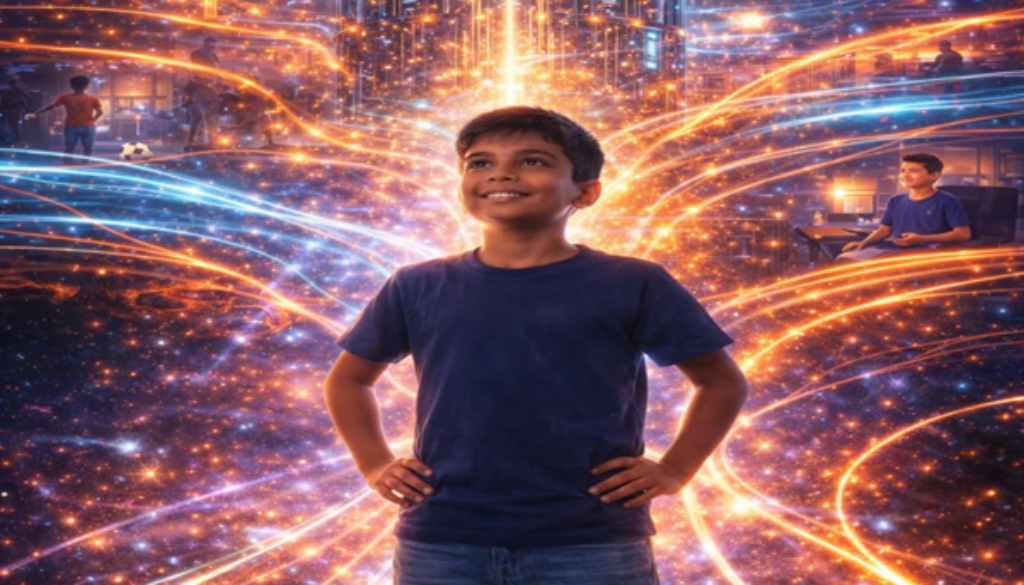
The Infinite Library of Our Universe.
Imagine you are standing inside a library that has no beginning and no end. Every book on its shelves tells the story of your life—but with small differences. In one book, you are wearing a blue T-shirt today. In another, you are wearing a red one.
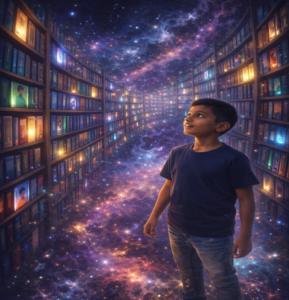
This is a simple way to understand the Many Worlds Theory. Scientists believe that our universe is like this infinite library, where every possible version of your life is happening at the same time.
The “ink” used to write these books is called quantum physics—a special branch of science that studies the tiniest parts of the universe, like atoms. Scientists have discovered something very strange: these tiny particles can exist in two places at once—until someone observes them.
A scientist named Hugh Everett III suggested an amazing idea: if tiny particles can exist in multiple states at once, maybe the entire universe can too!
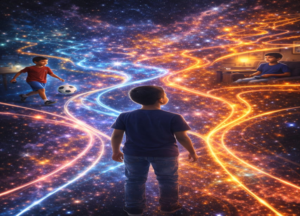
Whenever you make a choice, it’s like creating a new book in this library. This is called branching. For example, if you decide to play soccer, the universe splits into two—one where you go out and play, and another where you stay at home.
This means there isn’t just one “you.” There are millions of versions of you, each living out different choices in different “books.”
One of the most fascinating ideas related to this is called quantum immortality. It’s like a “choose your own adventure” story where your consciousness always continues in the version where you survive. Even if something goes wrong in one version, your mind continues in another version where you are safe.
You might wonder—why can’t we meet these other versions of ourselves? Scientists explain this using a concept called decoherence. It’s like invisible, soundproof walls between each book. Once a story begins, it becomes its own separate world, and the others become unreachable to us.
Even though we cannot see these parallel worlds, scientists are trying to use this idea in real life through quantum computers. These powerful machines can process many possibilities at the same time—like reading thousands of books at once! This helps solve complex problems much faster than normal computers.
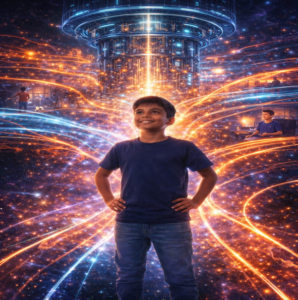
At first, the idea of an infinite library may feel strange or even scary. But it is also full of hope. It reminds us that no matter how many times we fail or feel sad, there could be another version of us somewhere who succeeded and is happy.
And maybe, that means we can also try again—and create our own better story.