

Unlocking the Secrets of Dinosaurs
Imagine stepping into a world millions of years ago — a world without humans, cities or roads, where enormous creatures walked across forests, mountains, deserts and swamps. This was the age of dinosaurs.

For over 160 million years, dinosaurs thrived as the dominant animals on land, evolving into a remarkable variety of species. Some were gigantic, while others were surprisingly small. Some were fierce hunters, while others peacefully fed on plants. Today, although we cannot see these magnificent creatures alive, their fossils allow us to piece together their story and uncover the secrets of the world they once ruled.
But have you ever wondered where the word “dinosaur” came from?
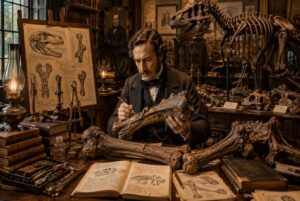
The name comes from the Greek words deinos and sauros, referring to a fearsome or powerful reptile or lizard. In 1842, English anatomist Richard Owen proposed the formal term Dinosauria after studying large fossilised bones discovered at several locations in southern England during the early nineteenth century.
What made these creatures so different from other reptiles?
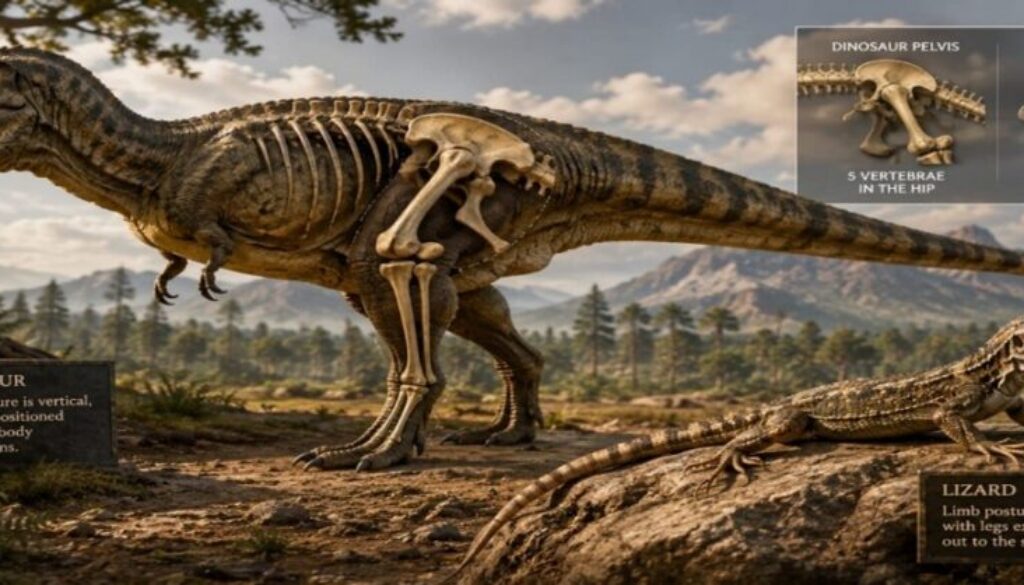
Owen noticed some fascinating features. Dinosaurs were large but clearly terrestrial, unlike many of the giant aquatic reptiles known at the time. They also had five vertebrae in their hips, whereas most known reptiles had only two. Most interestingly, dinosaurs did not hold their limbs sprawled out to the sides like lizards. Instead, their limbs were positioned under their bodies in a column-like manner, somewhat like elephants and other large mammals.
These discoveries helped scientists understand that dinosaurs belonged to an extraordinary group of creatures unlike the reptiles they already knew.
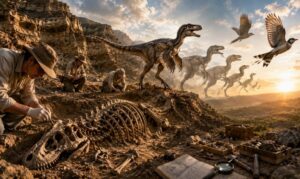
Even today, dinosaurs continue to reveal their secrets. Their fossils provide valuable clues about life millions of years ago and help scientists understand how organisms evolved over time. Although the age of dinosaurs ended long ago, their legacy continues through scientific discoveries and even through modern birds, which are connected to their ancient dinosaur ancestors.
Every newly discovered fossil is like another piece added to an enormous puzzle of Earth’s past. With each discovery, we understand a little more about these ancient titans and the fascinating world they once ruled.
Dinosaurs may have disappeared millions of years ago, but their story continues to inspire curiosity, discovery and wonder even today.